
Year-End Giving Letter for Church: Thank-You Template and Rules
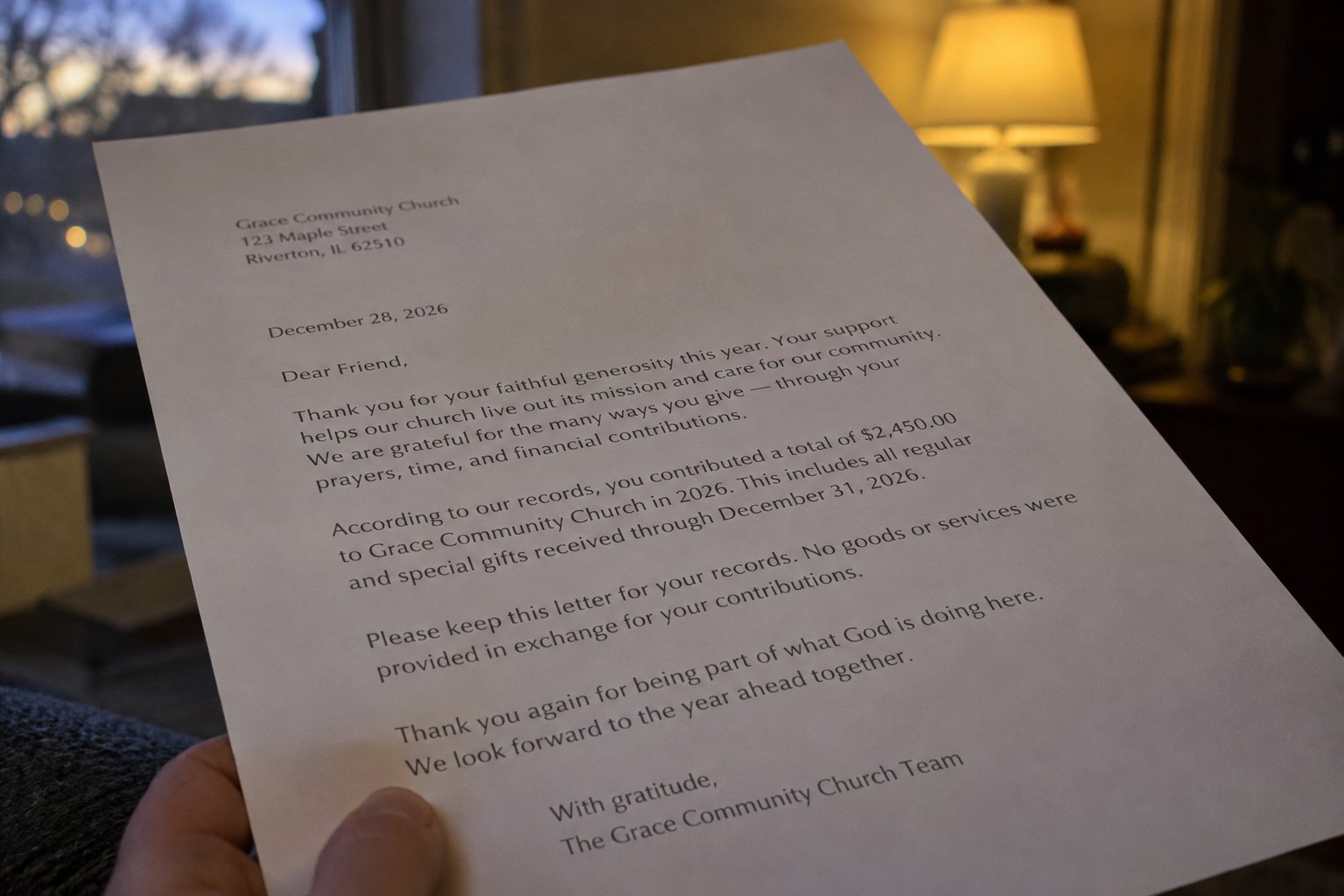
A year-end giving letter should do two jobs: thank the donor sincerely and provide a clear record of their contributions. Keep the gratitude personal, the giving details easy to check, and the acknowledgment wording accurate.
One annual acknowledgment can cover multiple gifts. The IRS permits paper or electronic delivery, so you can send a printed letter or an individually addressed email. The format matters less than including the required information. See IRS Publication 1771. (irs.gov)
Start with thanks, not another request
Open with two or three sentences of appreciation. Thank the donor for supporting the church's ministry without comparing their giving with anyone else's or suggesting that generosity determines their place in the congregation.
A simple opening is enough: Thank you for your generosity throughout the year. We are grateful for your support and the care it expresses for our church community.
If you add a ministry update, use something your church can verify. Name a completed project or describe an actual ministry activity. Do not invent an impact number, and avoid implying that a restricted gift paid for unrelated work.
For this letter, keep the focus on gratitude and recordkeeping. Put any new fundraising appeal in a separate message. Close with a named contact who can help with missing gifts or corrections, rather than leaving the donor to work out whom to ask.
What the acknowledgment needs to include
For a donor to substantiate a single charitable contribution of $250 or more, the written acknowledgment must identify the organization, state the monetary amount or describe donated property without valuing it, and address any goods or services provided in return. The wording must reflect what actually happened. See the IRS acknowledgment requirements. (irs.gov)
The $250 threshold applies to individual contributions, not the combined annual total of separate smaller gifts. For multiple monetary gifts covered by one acknowledgment, list each contribution, its date, and the total. Publication 526 explains these rules. (irs.gov)
Use this layout when preparing the letter and statement:
| Part | What to put there |
|---|---|
| Church identification | Church name, mailing address, and a contact for questions |
| Recipient | Donor name and current mailing or delivery details |
| Reporting period | Clearly identified calendar year |
| Monetary gift record | Individual contribution dates, amounts, and annual total |
| Property gifts, if applicable | Separate descriptions without church-assigned values |
| Acknowledgment wording | The appropriate statement about goods or services |
| Closing | Thanks, correction instructions, and sender's name and role |
The contribution information and acknowledgment wording follow the IRS requirements above; the contact details and layout are practical recommendations. (irs.gov)
You can place everything in one document. If you use a cover letter and attachment, label both with the donor and year, refer to the attachment expressly, and send them together. For a small office, a single combined document is a straightforward way to keep the parts together.
Choose the right goods-or-services statement
Do not select a sentence just because another church uses it. Review what the donor received in exchange for the gifts.
When nothing was provided in return
Use a clear sentence such as: The church did not provide any goods or services in exchange for the contributions listed in this acknowledgment.
This addresses the IRS requirement when no goods or services were provided. (irs.gov)
When only intangible religious benefits were provided
If accurate, say that the benefits provided in exchange consisted entirely of intangible religious benefits. The IRS allows this statement without describing or estimating the value of those benefits. (irs.gov)
This is not a catch-all for anything connected with church life. The IRS specifically excludes consumer goods, travel services, and education leading to a recognized degree from intangible religious benefits. See its quid pro quo contribution guidance. (irs.gov)
When the donor received goods or services
The acknowledgment generally needs a description and a good-faith estimate of their value. Do not use the no-goods-or-services sentence for these payments without reviewing the applicable exceptions. (irs.gov)
A separate disclosure rule generally applies when a payment exceeding $75 is partly a donation and partly payment for goods or services. The church must explain that the deductible portion is limited to the amount above the benefit's fair market value and provide a good-faith estimate of that value. This disclosure belongs with the solicitation or receipt, not merely in a later year-end mailing. (irs.gov)
When to send the letter
Aim to send the completed statement during January, preferably by January 31. The IRS describes that as typical practice, not a universal January 31 acknowledgment deadline. The donor must receive the acknowledgment by the earlier of the date they file their return or the return's due date, including extensions. (irs.gov)
Build your internal schedule backward from that target. Allow time to review transactions, resolve unidentified gifts, check addresses, and proofread the final documents. If a donor asks for an acknowledgment earlier, prioritize that request rather than waiting for the whole batch.
Recommend that donors retain the letter with their tax records. The IRS says the acknowledgment should be kept rather than attached to the individual income tax return. (irs.gov)
Prepare the records before drafting
Use this suggested workflow to keep the mailing manageable:
- Select the calendar year and gather contribution records from every collection method your church uses.
- Match entries to supporting records. Investigate duplicates, refunds, missing entries, and transactions assigned to the wrong person.
- Review gifts near the year boundary instead of moving them between years merely to make totals match. Refer uncertain timing questions to your church's tax adviser.
- Separate ordinary monetary gifts from transactions that need different acknowledgment treatment.
- Confirm donor names and delivery details. Do not assume that everyone sharing an address should receive the same statement.
- Generate the gift list and check that its total agrees with the reviewed contribution records.
- Have an authorized second reviewer check a sample of ordinary letters and every unusual case.
- Keep the issued version and a delivery log so you can track corrections.
For electronic delivery, send each donor only their own document. Avoid group messages containing giving details. Before a batch mailing, send a test to an authorized reviewer and inspect the attachment, recipient fields, year, and closing information.
Common mistakes to avoid
- Sending a warm thank-you without the required acknowledgment information. Gratitude alone does not supply the monetary amount or goods-or-services statement. (irs.gov)
- Showing only an annual monetary total instead of listing the individual gifts and dates in the annual acknowledgment. (irs.gov)
- Assigning a value to donated property in the church's acknowledgment. Describe the property instead. (irs.gov)
- Treating the template as suitable for every transaction. Noncash gifts can involve additional substantiation requirements. (irs.gov)
- Promising a particular tax deduction. Prefer a neutral acknowledgment and direct personal tax questions to the donor's adviser.
- Resending a corrected statement without clearly identifying it. Mark the replacement as corrected, show its issue date, and explain which earlier statement it replaces.
Final mailing checklist
- The opening sounds appreciative rather than transactional.
- The donor, church, and reporting year are correct.
- Every listed gift has been checked against the reviewed records.
- The itemized amounts add up to the total.
- The acknowledgment wording fits the listed gifts.
- Any attachment is included and clearly identified.
- The donor has a direct way to request a correction.
- The delivery method protects the donor's information.
This guide covers federal acknowledgment rules, not every state requirement or denominational procedure. Before adopting the template, check with your state adviser and applicable denominational finance office about any additional requirements.
Doing this in Chapel Desk
Chapel Desk supports per-household giving statements for a calendar year, including recorded cash and check contributions. You can publish statements privately to members, who can ask questions or request corrections on the statement.