
Types of Orthodox Churches: A Simple Guide to the Main Families
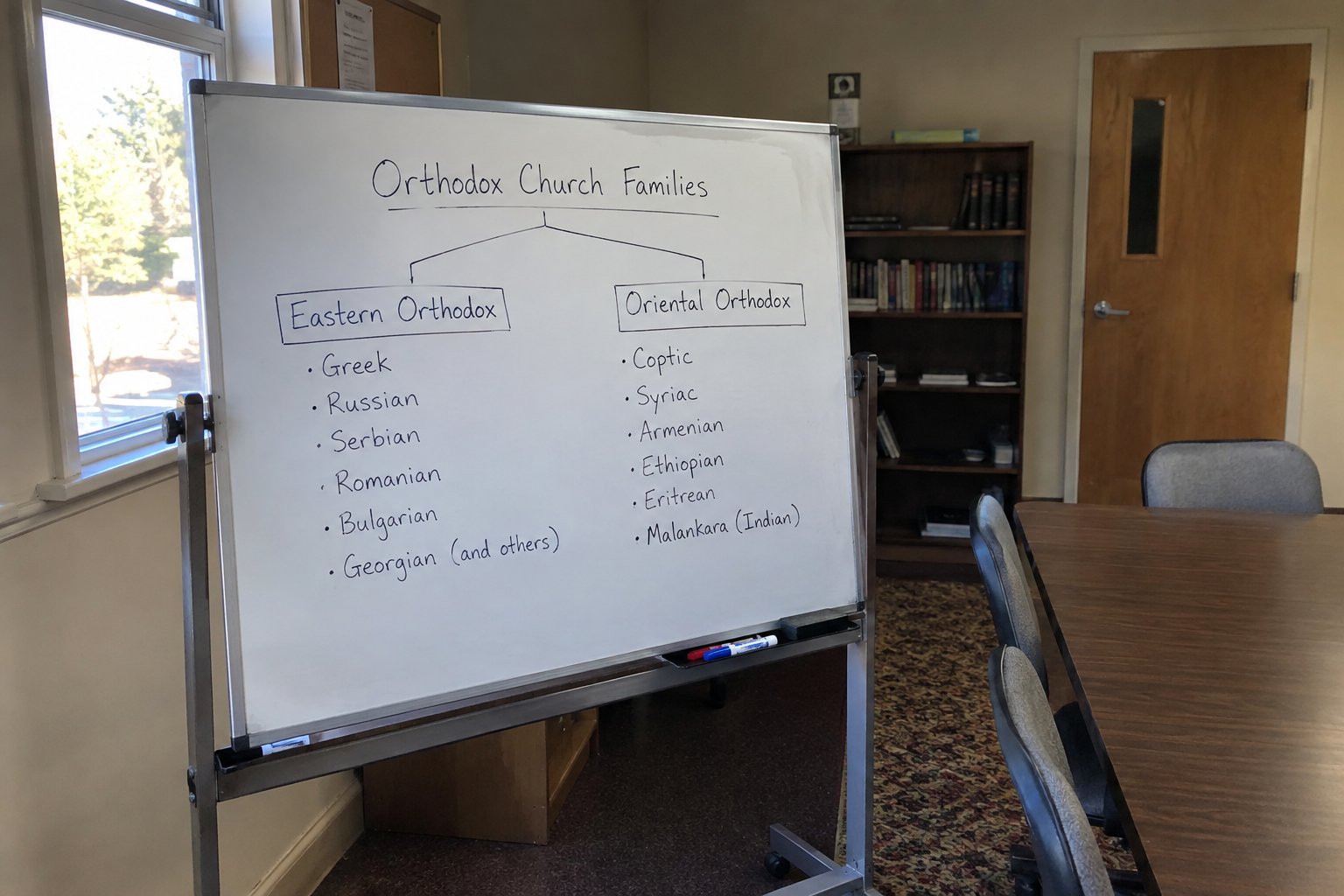
The clearest starting point for understanding the types of Orthodox churches is to distinguish Eastern Orthodox from Oriental Orthodox. These are two distinct church families, not interchangeable names for the same group. The World Council of Churches explains their relationship in its Oriental Orthodox overview. (oikoumene.org)
Next, separate the church family from the name of a particular church. Greek Orthodox and Russian Orthodox belong to Eastern Orthodoxy; Coptic Orthodox and Armenian Apostolic belong to Oriental Orthodoxy. Start with the family, then identify the particular church and local parish. (oikoumene.org)
The two main Orthodox families at a glance
Read this comparison chart from left to right. It is a classification guide, not an organizational chart showing one institution in charge of the others.
| Starting point | Church family | Examples within that family |
|---|---|---|
| Orthodox churches | Eastern Orthodox | Greek, Russian, Serbian, Romanian, Bulgarian, Georgian, Antiochian, Orthodox Church in America |
| Orthodox churches | Oriental Orthodox | Coptic, Armenian Apostolic, Syriac, Ethiopian, Eritrean, Malankara Orthodox Syrian |
These examples follow the World Council of Churches' Eastern Orthodox and Oriental Orthodox classifications. The Eastern list is illustrative, not a complete worldwide directory. (oikoumene.org)
Eastern Orthodox churches: what the different names mean
Eastern Orthodoxy includes multiple self-governing churches sharing the same Orthodox faith. Its organization is not simply a collection of unrelated denominations. The Orthodox Church in America explains this shared foundation in its overview of Orthodox organization. (oca.org)
Are Greek and Russian Orthodox different religions?
No. The OCA's comparison of Greek and Russian Orthodox churches explains that they share doctrine and Holy Tradition. Differences can include worship languages and musical traditions. An ethnic designation is not a separate statement of Christian belief. (oca.org)
For a visitor, the useful follow-up question is not simply, "Which nationality is this church?" Ask which languages a particular service uses. Do not assume that a Greek or Russian name tells you how much English you will hear. The OCA notes that the use of languages other than English varies between parishes. (oca.org)
What does autocephalous mean?
Autocephalous means self-governing. It describes church governance, not a different religion or a worship style. Eastern Orthodoxy includes several such churches, as outlined in the World Council of Churches overview. (oikoumene.org)
For an introductory parish description, you usually do not need a technical explanation of every level of independence. Prefer the church's official name and jurisdiction over an attempted worldwide ranking.
Where does the Orthodox Church in America fit?
The Orthodox Church in America, usually abbreviated OCA, belongs to Eastern Orthodoxy. It is also one of several jurisdictions listed in the US Assembly of Bishops' parish directory, alongside Antiochian, Greek, Serbian, Romanian, and others. Do not use "OCA" as shorthand for every Orthodox parish located in America. (oikoumene.org)
Oriental Orthodox churches: the names to recognize
The World Council of Churches describes six principal Oriental Orthodox traditions. Its Oriental Orthodox reference article identifies Coptic, Syrian, Armenian, Ethiopian, Eritrean, and Indian Malankara churches. (oikoumene.org)
| Church name | Classification |
|---|---|
| Coptic Orthodox Church | Oriental Orthodox |
| Armenian Apostolic Church | Oriental Orthodox |
| Syriac Orthodox Church, also called Syrian Orthodox | Oriental Orthodox |
| Ethiopian Orthodox Tewahedo Church | Oriental Orthodox |
| Eritrean Orthodox Tewahedo Church | Oriental Orthodox |
| Malankara Orthodox Syrian Church | Oriental Orthodox |
The WCC's family overview and member listings provide these church identities. Preserve a parish's own official wording rather than shortening its name to fit a category. (oikoumene.org)
Do not treat every word in a church name as a separate denominational label. For example, the Malankara Orthodox Syrian Church belongs to the Oriental Orthodox family; the word "Syrian" alone is not enough to identify the church's complete affiliation. Use the full name when searching or recording it. (oikoumene.org)
Why Eastern and Oriental Orthodox are separate
The historical division centers on the Council of Chalcedon in AD 451 and its teaching about Christ. Eastern Orthodox churches recognize Chalcedon; Oriental Orthodox churches accept the first three ecumenical councils but do not accept Chalcedon as the fourth. This is more than a difference in language or national heritage. (oikoumene.org)
The two families have held theological dialogue and reached agreements, but they have not established full communion with one another. Avoid describing them as completely interchangeable, or suggesting that dialogue has already created one united institution. The WCC overview explains both the separation and the dialogue. (oikoumene.org)
For practical purposes, refer questions about receiving Communion, joining a parish, or arranging a sacrament to the parish priest. A classification chart should help someone ask the right questions, not supply permission on the priest's behalf.
A simple flowchart for identifying a parish
Use this decision flow when checking a church listing or preparing an introduction. Begin with the parish's own description, then confirm it against its church body's directory.
| Step | Question | Next action |
|---|---|---|
| 1 | Does the parish state its church family and jurisdiction? | Record the full wording, then go to step 2. |
| 2 | Can you find it in that church body's official directory? | Match the location and parish name, then go to step 3. |
| 3 | Does the directory confirm Eastern Orthodox affiliation? | Record Eastern Orthodox and the specific jurisdiction. |
| 4 | Does it instead confirm Oriental Orthodox affiliation? | Record Oriental Orthodox and the specific church. |
| 5 | Is the affiliation unclear or described differently? | Stop and ask the parish office rather than guessing. |
For US Eastern Orthodox parishes, the Assembly of Bishops' directory lets you search by location and refine by jurisdiction. It is not a directory of both Orthodox families. For an Oriental Orthodox parish, use its own church or diocesan directory. (assemblyofbishops.org)
Where do Eastern Catholic churches fit?
Do not automatically classify a church as Orthodox because its name includes "Eastern" or "Byzantine." Eastern Catholic churches are Catholic churches in union with the Bishop of Rome, as explained by the Archdiocese of Baltimore. Keep this category separate from Eastern Orthodox and Oriental Orthodox in your records. (policy.archbalt.org)
Doing this in Chapel Desk
Chapel Desk lets a parish explain its church family, jurisdiction, and visitor information on its About page or custom pages. Its leadership directory and document library can keep approved contact details and reference material easy to find.
Sources
- World Council of Churches: Orthodox churches (Oriental)
- World Council of Churches: Orthodox churches (Eastern)
- World Council of Churches: Oriental Orthodox Churches
- Orthodox Church in America: Greek Orthodox and Russian Orthodox
- Orthodox Church in America: How is the Orthodox Church organized and held together as one worldwide Church?
- Assembly of Canonical Orthodox Bishops of the United States of America: Directory of Orthodox Christian Parishes
- Archdiocese of Baltimore: 101 Rite Of Christian Initiation Of Adults
- Orthodox Church in America: Directories